Leticia de Mello
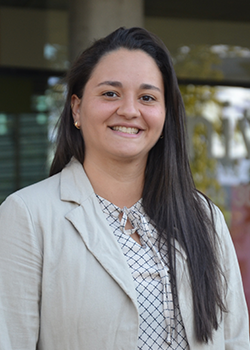
Doctoral Researcher Leticia de Mello
Faculty of Humanities, Social Science & Education at OVGU
Leticia de Mello is a doctoral researcher at Otto-von-Guericke University Magdeburg, as a member of the Humanitarian Research Network in Germany, funded by the Gerda Henkel Foundation. In her PhD project, Humanitarian Imaginaries: The Constitution of Humanitarian Crises in Latin America, she examines how humanitarian crises are discursively constructed through narratives and visual representations by actors in the Global South, and how these representations contribute to the formation of humanitarian imaginaries.
Leticia holds a Master’s degree in Peace and Conflict Studies from Otto-von-Guericke University Magdeburg - Germany as a DAAD Helmut-Schmidt Programme scholar, and a Bachelor’s degree in International Relations from PUC Minas – Brazil.
Her work draws on academic and professional experience across diverse international contexts and her multilingual proficiency in Portuguese, English, Spanish, and German.
With a strong engagement with critical and decolonial approaches, Leticia has a solid academic background in Peace Education and a keen interest in Political Psychology, International Development and Security, especially in relation to humanitarian narratives and the governance of crises. Passionate about sports (especially football), she sees its potential as a powerful tool for education, conflict transformation, and social change.
- Humanitarianism
- Peace Education
- Latin America
- Sports for Development and Peace.
Initial project description: Humanitarian crises are often portrayed as self-evident emergencies defined by urgency, scale, and human impact. Yet the designation of an event as a “humanitarian crisis” is shaped by processes of interpretation, representation, and political negotiation. My PhD project, Humanitarian Imaginaries: The Constitution of Humanitarian Crises in Latin America, explores how humanitarian crises are constructed and communicated through narratives and representations by actors in the Global South.
In recent years, Global South organizations have gained increasing visibility within international humanitarian debates, particularly in discussions surrounding localization and calls to decolonization. Despite this growing attention, their own perspectives on crises and humanitarian responses remain comparatively underexplored. This project therefore seeks to put in evidence how actors in Latin America interpret, frame, and communicate humanitarian crises, and how their narratives may reinforce, adapt, or challenge dominant understandings of humanitarian emergencies.
The research also considers the expanding role of “non-traditional” humanitarian stakeholders, including civil society organizations, private institutions, and initiatives emerging from fields such as Sport for Development and Peace (SfD), in shaping local narratives of crisis and response. By examining how such actors represent crises and articulate forms of intervention, the project analyses how humanitarian imaginaries are produced, circulated, and contested. Through centering perspectives from Latin America, this PhD research contributes to critical and decolonial debates on humanitarianism and offers new insights into how knowledge about crises is produced and mobilized in local humanitarian governance.