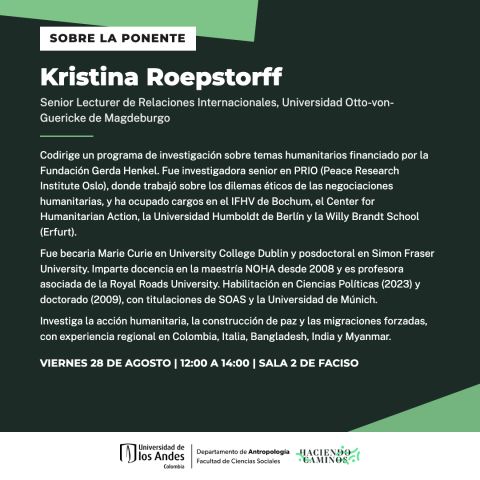
Talk by PD Dr. Roepstorff on Negotiating Humanitarianism
Last week, PD Dr. Kristina Roepstorff gave a talk at Universidad de Los Andes titled "Negotiating Humanitarianism: Localisation and Humanitarian Legitimacy”, exploring what localisation can contribute to broader debates in critical humanitarian studies.
Localisation has become one of the defining agendas in contemporary attempts to reform humanitarian action, with debates largely centred on the redistribution of resources, responsibilities, and decision-making to local actors. While these discussions have generated important insights into questions of power, partnership, and representation, they also invite us to ask broader questions about legitimacy: Who is recognised as a humanitarian actor? On what basis are humanitarian claims considered legitimate? And how are these claims negotiated in practice?
Drawing on her research on localisation, Kristina Roepstorff argued that rather than approaching localisation solely as a policy agenda or an institutional reform process, it offers a productive entry point for examining how humanitarian legitimacy is established, negotiated, and contested among a plurality of actors – including international organisations, local NGOs, faith-based organisations, community-based organisations, public authorities, and affected communities. This perspective, she suggested, shifts attention to humanitarian space as the outcome of ongoing negotiations over who can act, speak, and claim authority in the name of humanitarianism. The talk traced how these negotiations shape humanitarian practice, and what they reveal about the processes through which humanitarian legitimacy is claimed and recognised.